

Wahoo
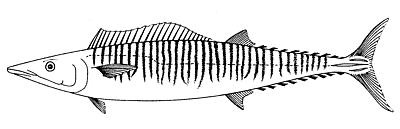
Wahoo are the speed demons of the offshore world, capable of blistering runs over 50 mph that can empty a reel in seconds. Anglers chase them for the fight and for meat that ranks among the best eating in the ocean.
Wahoo have a long, slender, torpedo-shaped body with a pointed head and a mouth full of flat, triangular teeth. They are steel blue to greenish on top fading to silver below, with 20 to 30 vertical dark blue bars running down the sides. Those bars can fade fast after the fish dies or gets stressed, so do not rely on them alone.
The main mix-up is with king mackerel and small barracuda. Wahoo have a much longer, more pointed snout than a king mackerel and a distinct set of vertical bars that kings lack entirely, kings just show a plain silver side. The dorsal fin is another tell: wahoo have a long, low first dorsal fin that runs most of the length of the back, while a king mackerel's first dorsal is shorter and folds into a groove. Barracuda are longer and thinner still, with a single dorsal fin set far back near the tail and a underbite jaw, versus the wahoo's evenly matched jaws and dorsal fin set forward near the head.</identification_md"> <parameter name="faqs">[{"question": "How big do wahoo get?", "answer": "Most fish caught run 20 to 50 pounds, but they can top 100 pounds. Anything over 80 pounds is a genuinely big fish."}, {"question": "What do wahoo eat?", "answer": "Small baitfish and squid, mostly. They chase down flying fish, small mackerel, and anything else that gets caught in open water."}, {"question": "When and where is the best time to catch wahoo?", "answer": "Wahoo live in open ocean water, usually near drop-offs, weed lines, or current edges offshore. They bite year round in warm water but activity often picks up around temperature breaks and during the cooler months in subtropical areas."}, {"question": "Are wahoo good to eat?", "answer": "Yes, wahoo is excellent table fare. The meat is firm, white, and mild, and it holds up well to grilling, searing, or raw preparations like sashimi."}, {"question": "Why do wahoo strip line so fast?", "answer": "They are one of the fastest fish in the ocean, capable of bursts over 50 miles per hour. That speed is why anglers use wire leaders and heavy drag settings when targeting them."}, {"question": "Do wahoo spawn in a specific season?", "answer": "In most warm offshore waters wahoo spawn over an extended season through spring and summer, releasing eggs into open water rather than nesting like inshore species."}]
The app forecasts these conditions for your spot, and learns which ones you catch on.
Season
Where it lives
Wahoo roam warm offshore waters across the Gulf, the southern Atlantic coast, and the tropical and subtropical Pacific waters off Hawaii. They favor blue water well beyond the beach, often near drop-offs, seamounts, floating debris, weed lines, and offshore rigs where bait concentrates.
They are not schooling fish in the way tuna are. You typically find them alone or in small, loose groups, cruising near the surface or down to a couple hundred feet, especially around structure that holds smaller fish.
What it eats
Wahoo eat other fish almost exclusively. Flying fish, small tuna, mackerel, squid, and anything else fast and silvery in open water. They hit prey with a slashing bite rather than swallowing it whole, which is why leaders get sliced so often.
How to catch it
High-speed trolling is the standard method. Run lures or rigged ballyhoo behind planers or lead-core line at 10 to 15 knots, well above normal trolling speed, since wahoo are built to chase down fast prey. A short length of heavy wire leader is essential. Their teeth and speed will cut through mono or light wire in an instant.
Many anglers also fish live bait or vertical jig near structure and current edges where wahoo hold, dropping a fast metal jig to depth and ripping it back up in erratic bursts. Early morning and around dawn tends to produce the best bite. Because runs are so fast and violent, use a reel with a strong drag and plenty of line capacity, and check your regional saltwater regulations for size and bag limits before you keep one.
- How big do wahoo get?
- Most wahoo caught run 20 to 50 pounds, but fish over 100 pounds show up every year. They are one of the fastest-growing fish in the ocean, so a school can have a wide range of sizes.
- What do wahoo eat?
- Wahoo eat other fish almost exclusively, including small tuna, mackerel, flying fish, and squid. Their teeth are built for slicing prey in half rather than swallowing it whole.
- When is the best time to catch wahoo?
- Wahoo fishing is usually best when water temperatures warm up in spring and again in fall as they follow bait migrations. Early morning and around structure like weed lines, rips, and drop-offs are consistently productive.
- How fast are wahoo, really?
- Wahoo are one of the fastest fish in the ocean, capable of short bursts over 50 miles per hour. That speed is why they are known for stripping line off a reel in seconds and why anglers use wire leader to avoid bite-offs.
- Are wahoo good to eat?
- Yes, wahoo have firm, white, mild flesh that is popular grilled, seared, or used raw in sashimi. They are considered one of the better eating fish among offshore pelagics.
- Do wahoo school up or swim alone?
- Wahoo are usually solitary or found in small, loose groups rather than tight schools like tuna. Catching one does not always mean more are close by, though they do gather around bait-rich structure.