

Walleye
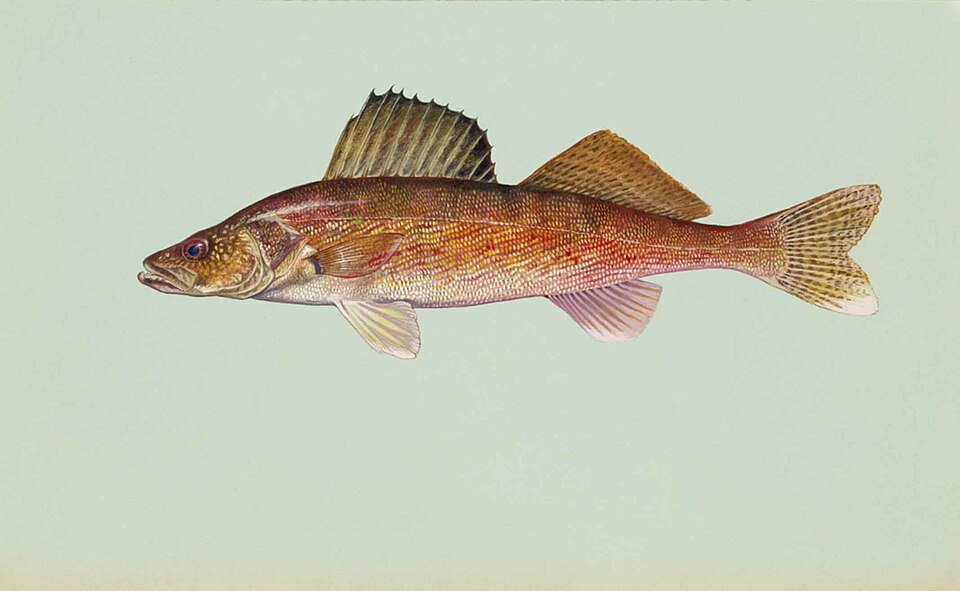
A cold-water predator with huge, glassy eyes built for hunting in the dark. Walleye are prized table fare and a real challenge to pattern, which is why serious anglers chase them in the mountain reservoirs of the Carolinas and Virginia.
Walleye are most often confused with sauger, a smaller cousin they share water with across much of their range. The easiest tell is the tail: walleye have a white blotch on the bottom tip of the tail fin, and sauger do not. Look at the first dorsal fin too. Sauger have distinct black spots scattered across that spiny front dorsal fin, while a walleye's dorsal fin is mostly clear or dusky without sharp spots. Walleye also run bigger on average, with a more olive-gold, mottled body, while sauger tend to be more uniformly brassy gray.
The other mix-up is with yellow perch, since both have that big cloudy, glassy eye and similar coloring. Perch are much smaller, deeper bodied, and marked with bold dark vertical bars down the side. Walleye are longer and more torpedo shaped, with a large mouth full of sharp teeth that a perch simply does not have. If you are holding a fish with a mouth built for swallowing baitfish whole, it is a walleye, not a perch.</identification_md> <parameter name="faqs">[{"question": "When do walleye spawn?", "answer": "Walleye spawn in early spring, right after ice out in northern waters, when water temps hit the mid 40s to low 50s. They move onto gravel or rocky shorelines and river current at night to spawn, then scatter back to deeper water."}, {"question": "What do walleye eat?", "answer": "Mostly other fish. Shad, shiners, perch, and small baitfish make up most of their diet, and they will also eat crayfish and insects when baitfish are scarce. Their eyes are built for hunting in low light, which shapes when and how you catch them."}, {"question": "What is the best time to catch walleye?", "answer": "Dawn, dusk, and after dark are the best windows, since walleye feed heavily in low light and often move shallow to do it. On cloudy or windy days they will feed longer into daylight hours than they would under bright sun."}, {"question": "How big do walleye get?", "answer": "Most fish caught run 14 to 20 inches and one to three pounds. Trophy fish push past 10 pounds and over 30 inches, and those big females are usually released to keep the population healthy."}, {"question": "Are walleye good to eat?", "answer": "Yes, walleye are considered one of the best tasting freshwater fish around. The fillets are firm, white, and mild, with few bones, which is a big reason they are so popular on the table."}, {"question": "Do I need to worry about regulations when keeping walleye?", "answer": "Many waters have slot limits or reduced bag limits to protect large breeding females, so check local rules before you keep fish. It is common practice to release the biggest walleye you catch and keep fish in the middle of the size range for eating."}]
The app forecasts these conditions for your spot, and learns which ones you catch on.
Season
Where it lives
Deep, cool reservoirs and tailwaters, mostly in the mountains and foothills. In North Carolina that means lakes like Hiwassee, Chatuge, and James, plus the Nantahala and Little Tennessee systems. Virginia has better numbers, with lakes like Smith Mountain and South Holston holding solid populations. South Carolina has only scattered, stocked pockets.
Walleye hold near rocky points, humps, and drop-offs close to deep water. Their big eyes are built to gather light, so they push shallow to feed at night and slide back down to depth once the sun is up. In summer they stack up near the thermocline where the water stays cool.
What it eats
Mostly small fish: shad, minnows, and yellow perch make up most of the diet, along with crayfish and the occasional insect larva. Walleye feed heaviest in low light, using their eyes and lateral line to pick off baitfish in murky or dark water.
How to catch it
Fish dawn, dusk, and after dark for your best shot. A live nightcrawler or minnow on a slip-sinker rig, dragged slowly along a rocky point or channel edge, is the standard approach. Jigging a bucktail or soft-plastic swimbait along the bottom near drop-offs also works, especially at night under a light that draws in baitfish.
In early spring, walleye run up tributary arms and tailwaters to spawn over gravel and rock. That is the most reliable window to find them concentrated and catchable from shore. Through summer and fall, troll deep-diving crankbaits or bottom bounce nightcrawler harnesses along river channels and points near the thermocline.
- When do walleye spawn?
- Walleye spawn in early spring, right after ice-out in the northern part of their range, when water temperatures hit the low to mid 40s. They spawn at night over gravel or rocky shoals, often in current below dams or at river mouths.
- What do walleye eat?
- Mostly smaller fish like shad, shiners, and young perch, along with crayfish and insect larvae. They are nocturnal hunters with light-gathering eyes, which is why they feed heavily around dawn, dusk, and after dark.
- When is the best time to catch walleye?
- Low light is key. Early morning, evening, overcast days, and after dark are your best windows, especially in clear water where walleye avoid bright sun. Spring and fall also tend to produce better daytime action than the heat of summer.
- How big do walleye get?
- Most walleye caught run 14 to 20 inches and one to three pounds. Trophy fish push past 28 inches and ten pounds, and the largest walleye on record are over 20 pounds, though fish that size are extremely rare today.
- Are walleye good to eat?
- Yes, walleye are widely considered one of the best-eating freshwater fish. The white, flaky fillets have a mild flavor and few bones, which is a big reason they are so popular as a target species.
- Do I need to worry about regulations when keeping walleye?
- Many waters have specific size and bag limits for walleye, and some have slot limits protecting mid-size breeding fish. Always check local rules before you keep a limit, since they vary a lot by lake and state.