

Weakfish
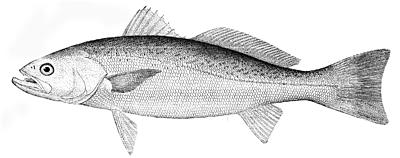
A silvery, delicate-mouthed member of the drum family known for its speckled back and soft bite. Weakfish can show up in good numbers along the Carolina and Virginia coast, but their population swings hard year to year, so when they run, anglers who know the timing cash in.
Weakfish get confused with spotted seatrout and sand seatrout, since all three share the same slim body, silvery sides, and dark speckled back. On a weakfish, the spots blend together in loose, wavy lines that run diagonally above the lateral line, and the back often shows tints of green, purple, and copper that spotted seatrout do not have. Spotted seatrout show bold, distinct round black spots that stay separate rather than merging into lines, and they usually lack that iridescent sheen. Sand seatrout are pale and washed out by comparison, with faint or no spotting at all and a more yellowish cast to the fins.
Another giveaway is the mouth and teeth. Weakfish have a mouth full of small, even teeth and no prominent canines, while spotted seatrout carry one or two large fang-like teeth at the tip of the upper jaw that you can see even without opening the mouth wide. Weakfish also tend to have a more slender, elongated body and a soft mouth that tears easily, which is where the name comes from. Handle hooked fish gently and expect hooks to pull free more often than with other members of the drum family.</identification_md> <parameter name="faqs">[{"question": "When do weakfish spawn?", "answer": "Weakfish spawn in spring and summer, generally from April through August depending on water temperature. They gather in bays, sounds, and river mouths near the coast to spawn, often at night."}, {"question": "What do weakfish eat?", "answer": "Weakfish feed on small baitfish like anchovies, menhaden, and silversides, along with shrimp, crabs, and worms. They hunt mostly by sight and ambush prey in current lines and over structure."}, {"question": "What is the best time to catch weakfish?", "answer": "Early morning and evening are best, especially around tide changes when bait gets pushed through channels and inlets. Spring and fall tend to produce the most consistent action as fish move in and out of coastal waters."}, {"question": "How big do weakfish get?", "answer": "Most weakfish run one to three pounds, with fish over five pounds considered a good catch. The largest on record top eighteen pounds, though fish that size are rare today."}, {"question": "Are weakfish good to eat?", "answer": "Yes, weakfish have mild, flaky white meat that many anglers rate highly. Handle them carefully and keep them cold quickly, since the flesh softens fast in warm weather."}, {"question": "Why are they called weakfish if they fight hard?", "answer": "The name comes from their soft, easily torn mouth tissue, not a lack of fight. Hooks pull free easily, so steady pressure and a soft hookset work better than a hard yank."}]
The app forecasts these conditions for your spot, and learns which ones you catch on.
Season
Where it lives
Weakfish favor sounds, inlets, and the surf zone over sand and mud bottom. Look for them around inlet mouths, channel edges, and grass flats in coastal sounds like Pamlico and Core Sound. They also stack up near piers and jetties when bait is thick.
They move inshore and north in spring, spend summer in bays and sounds, then push back out to deeper coastal waters and south as it cools. Big females tend to hold in deeper holes and channels, while smaller fish spread across the flats.
What it eats
Shrimp, small crabs, and baitfish like mullet, menhaden, and anchovies make up most of their diet. Weakfish feed up in the water column more than most drum, often chasing schools of bait near the surface at dawn and dusk.
How to catch it
Live shrimp under a popping cork is the standard rig in North Carolina sounds, fished slow over grass flats and channel edges on an incoming tide. Soft plastic paddletails and shrimp imitations on a light jighead also work well, especially worked with a slow, twitching retrieve near structure.
The name is not for show: weakfish have soft, tearing mouths, so keep your drag loose and avoid horsing them in. A steady retrieve and patient fight beats a hard hookset every time. Fish early or late in the day when they are up feeding on bait near the surface, and target inlets in spring and fall when fish are moving through.
- placeholder
- placeholder