

White Bass
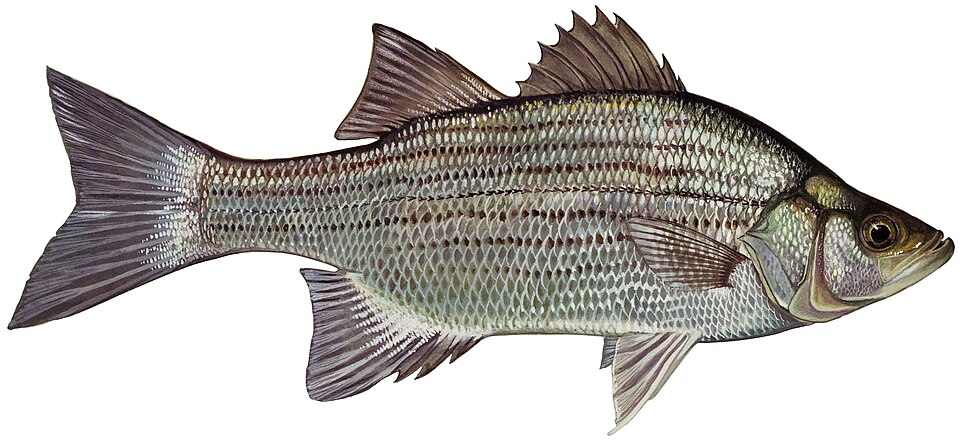
White bare the fish that make the news every spring when they run up rrivers by the thousands. They are smaller than their striper cousins, but they school hard and hit fast, and a good run means catching fish every cast.
White bass get mixed up with striped bass, hybrid striped bass (wiper), and white perch, so look closely before you decide what you caught.
Striped bass and hybrid striped bass are the main lookalikes. White bass have a deeper, more compressed body and a single faint gray-gold sheen, while true stripers are longer and more torpedo-shaped. The stripe pattern is the real tell: white bass have several dark horizontal lines running along the side, but only one line usually runs unbroken all the way to the tail, and the rest are faint or broken. Striped bass have multiple bold, continuous stripes from gill to tail. Hybrids fall in between, with stripes that are broken but bolder than a pure white bass. Body depth is another clue: white bass look almost egg-shaped from the side compared to the sleeker stripers and hybrids.
White perch cause confusion too, especially where ranges overlap, but white perch have no stripes at all, just a plain silvery-olive body, and a smaller mouth. White bass also have two dorsal fins that are clearly separated, while a white perch's dorsal fins are closer together and nearly touching. Check the mouth as well: white bass have a tooth patch on the tongue in two small parallel patches, which white perch lack.
The app forecasts these conditions for your spot, and learns which ones you catch on.
Season
Where it lives
Reservoirs and large rivers with a connection to a big lake system. In North Carolina look for them in Kerr Lake, Lake Norman, High Rock Lake, and the rivers that feed them. They also show up in some Piedmont and mountain reservoirs where they've been stocked or have established themselves.
Most of the year white bass roam open water in schools, following shad. In spring they push up into feeder creeks and rivers to spawn over gravel and current, which is when they become easy to find from the bank.
What it eats
Shad is the main course, especially threadfin and gizzard shad. White bass also eat small minnows and insects when shad are scarce. They feed in packs, driving baitfish to the surface, which is the tell-tale sign you are looking for.
How to catch it
In spring, fish the run. Head to the rivers and creeks feeding major reservoirs from March into April and cast small jigs, inline spinners, or curl-tail grubs upstream, letting them swing through the current. A white or chartreuse 1/8 to 1/4 ounce jig works most days.
The rest of the year, watch the open water on the lake. When you see gulls diving or shad skipping on the surface, that's a school of white bass busting bait. Idle in close, cut the engine, and cast small topwater lures or spoons into the commotion. It rarely lasts more than a few minutes, so work fast and be ready to move again when it stops.
- When do white bass spawn?
- In spring, usually when water temps hit the mid 50s to low 60s. They run upstream into rivers and creek arms in big numbers, which is when most anglers target them.
- What do white bass eat?
- Mostly shad and other small baitfish, along with insects and small crustaceans. They feed in aggressive, fast-moving schools, often chasing bait to the surface.
- What is the best time to catch white bass?
- Spring spawning runs are the easiest time, when they stack up in rivers and tributaries. In summer and fall, early morning and evening surface feeding frenzies are your best shot.
- How big do white bass get?
- Most run 10 to 15 inches and a pound or two. Anything over 3 pounds is a solid fish, and the species rarely tops 5 pounds.