

White Crappie
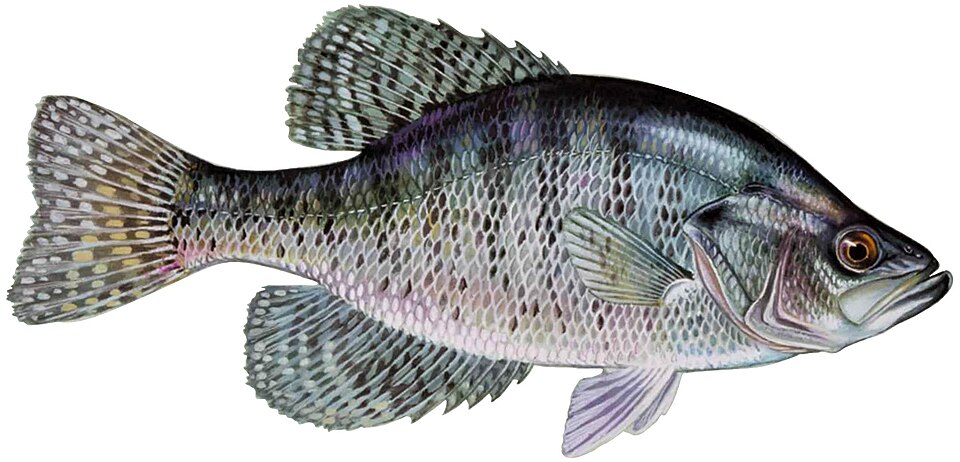
A schooling panfish that stacks up around brush and bridge pilings. White crappie bite best in early spring and reward anglers who fish slow and near cover.
White crappie are most often mixed up with black crappie, and the two swim in the same lakes throughout much of the country. The easiest check is the dorsal fin. White crappie have five or six spines in the dorsal fin and a body that runs slightly longer and more torpedo-shaped. Black crappie have seven or eight dorsal spines and a deeper, rounder body. Color pattern helps too: white crappie show dark vertical bars or blotches arranged in faint stripes down a silvery-green side, while black crappie are speckled with irregular black spots scattered with no real pattern.
People also confuse small white crappie with white bass or yellow bass, especially over open water. White bass and yellow bass have true continuous stripes running the length of the body and a single spiny dorsal fin separate from the soft dorsal, while crappie have a deep, thin, almost papery body, a large mouth for their size, and two dorsal fins that sit close together. Hold one in your hand and the difference in body shape alone settles it.
The app forecasts these conditions for your spot, and learns which ones you catch on.
Season
Where it lives
Reservoirs, lakes, and slow rivers with some stain to the water. White crappie tolerate murkier, warmer water than their black crappie cousins, which is part of why they do so well in Piedmont reservoirs across North Carolina.
Look for them around submerged brush piles, standing timber, bridge pilings, and boat docks. They suspend over deeper water most of the year but push shallow into coves and creek arms to spawn in spring.
What it eats
Mostly small shad and minnows, plus insect larvae and tiny crustaceans when baitfish are scarce. Crappie feed by ambush, holding near cover and darting out to grab something passing by rather than chasing food far.
How to catch it
A small minnow under a slip float, set to hang just above where you mark fish or brush, is the standard rig and it still works better than almost anything else. Fish it slow and be patient. Crappie often bite light, so watch for the float to simply tilt or slide off rather than plunge under.
In spring, work the backs of coves and creek arms as the water warms into the 60s, casting small jigs (1/16 to 1/32 ounce, marabou or curly tail) around brush and stumps in two to six feet of water. In summer and winter, find brush piles or standing timber in 15 to 25 feet with a graph and vertical jig or drop a minnow straight down into them. Lakes like Jordan, Kerr, and Santee Cooper are known white crappie waters worth targeting this way.
- When do white crappie spawn?
- They spawn in spring when water temps hit the mid 50s to low 60s, earlier than most other panfish. Males move shallow first to fan out nests near brush, stumps, or dock pilings, and females follow once the water warms a bit more.
- What do white crappie eat?
- Small minnows and shad make up most of their diet as adults, with insects and tiny crustaceans filling in when baitfish are scarce. A small minnow or a soft plastic jig that imitates one will catch them almost anywhere.
- What is the best time to catch white crappie?
- Spring around the spawn is the easiest time, since fish move shallow and bite aggressively near cover. In summer and winter they school tight around deep structure and brush piles, so you need electronics or known spots to find them.
- How big do white crappie get?
- Most run 8 to 12 inches, with a good one pushing a pound or more. Fish over 2 pounds are trophy-class and show up mostly in fertile lakes and reservoirs with a strong shad forage base.
- Are white crappie good to eat?
- Yes, they are one of the most popular panfish on the table. The white, flaky fillets are mild and hold up well fried or baked.
- Do I need to worry about limits on white crappie?
- Many waters have daily bag limits and sometimes a minimum length, especially on popular reservoirs, since crappie are easy to overharvest once a school is located. Check local regulations before keeping a big stringer.