

White Seabass
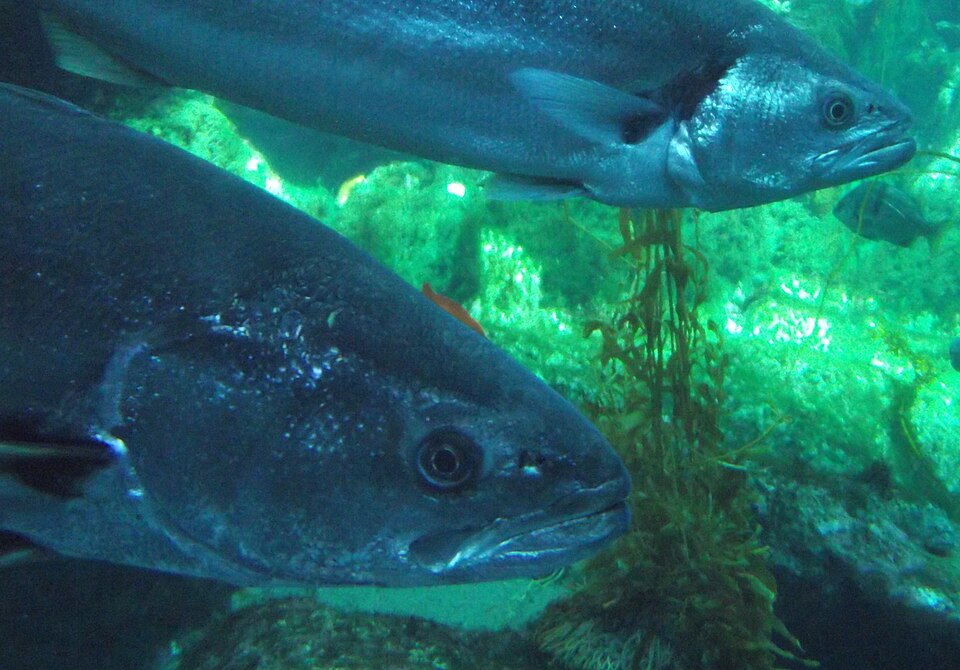
A big, wary drum that prowls the Pacific kelp beds. White seabass grow large, fight hard, and make anglers work for every one, which is exactly why they are so prized.
White seabass are actually a member of the drum family, not a true bass, and they get confused most often with California yellowtail and with large corvina or weakfish relatives that share the same slim, silvery build. Look at the chin and mouth first: white seabass have a large mouth that reaches back under the eye, with a soft, faintly yellowish or coppery cast along the lower jaw, and no barbels or chin whiskers like some drum species have. The body is elongated and less deep-bodied than yellowtail, with a straight lateral line and a small loose flap of skin at the tip of the tail rather than the stiff, sharply forked tail of a yellowtail.
Color is another giveaway. White seabass run dark blue to gray or coppery on the back, fading to bright silver on the sides and white on the belly, sometimes with faint dark streaks running along the upper body. Young fish under a few pounds often show three or four dark vertical bars on the sides, which fade as the fish matures, and those juveniles are frequently mistaken for spotted bay bass or other small drum. A true adult white seabass, with its long body, big mouth, and lack of spots or bars, is hard to mistake for anything else once you know what to check.
The app forecasts these conditions for your spot, and learns which ones you catch on.
Season
Where it lives
White seabass live along the Pacific coast, from kelp forests and rocky reefs to deep drop-offs near shore. They favor structure: kelp beds, submerged rock piles, and points where current sweeps bait past a hiding spot. You will also find them around offshore islands and over sandy flats near reefs where squid come to spawn.
They move with bait and water temperature. In spring and summer they push closer to shore and into shallower kelp as squid and anchovies show up. In cooler months they drop deeper and scatter, making them harder to pin down.
What it eats
Squid is the top item on the menu, especially during spring and summer spawning runs when squid stack up over reefs. White seabass also eat anchovies, sardines, herring, and other small baitfish, plus the occasional crustacean picked off the bottom. They hunt mostly by sound and scent in low light, which is why dawn, dusk, and night bites are usually best.
How to catch it
Live bait is the standard approach. A live squid or anchovy on a sliding sinker rig, fished near the bottom around kelp edges or reef structure, is the most consistent way to connect. Keep the bait lively and let it swim naturally rather than working it hard.
Drifting or anchoring over known reef structure at first light or after dark improves your odds, since these fish feed heavily in low light and can be spooky in bright sun. Heavier fluorocarbon leader helps against their rough mouths and the abrasive structure they hold near. This is not a beginner's fish: they can be difficult to locate, easily spooked, and inconsistent biters, so expect to put in time before you connect. Check your state's regulations before you go, since white seabass are managed with minimum size limits and seasonal rules that change from year to year.
- How big do white seabass get?
- Most fish caught run from 10 to 30 pounds, but they can grow past 80 pounds and over 5 feet long. A 40 pound fish is a serious trophy for most anglers.
- What do white seabass eat?
- They feed heavily on squid, anchovies, sardines, and other small schooling baitfish. Live squid is considered the top bait where it is available, and matching whatever bait is running that season is the key to consistent success.
- When is the best time to catch white seabass?
- Spring through early summer is prime time, when fish move inshore to spawn and follow squid and baitfish schools. Early morning and low light periods, including night fishing around structure, also produce well.
- Are white seabass good to eat?
- Yes, the white, mild fillets are considered excellent table fare and are among the most sought after eating fish on the West Coast. Fresh, never frozen fillets are especially prized.
- Where do you find white seabass?
- Look for them around kelp beds, rocky reefs, drop-offs, and structure where squid spawn or baitfish stack up. They often hold near the bottom in deeper water during the day and move shallower to feed at dawn, dusk, and at night.
- Is there a size or bag limit on white seabass?
- Yes, in most areas they are managed with a minimum size limit and a daily bag limit, and the season or limit can change year to year. Always check current regulations before you keep one.