

White Sturgeon
The biggest freshwater fish in North America, a living dinosaur that can outweigh a grown man. Landing one is a bucket-list fight, but this is an expert-level pursuit with strict rules on handling and harvest.
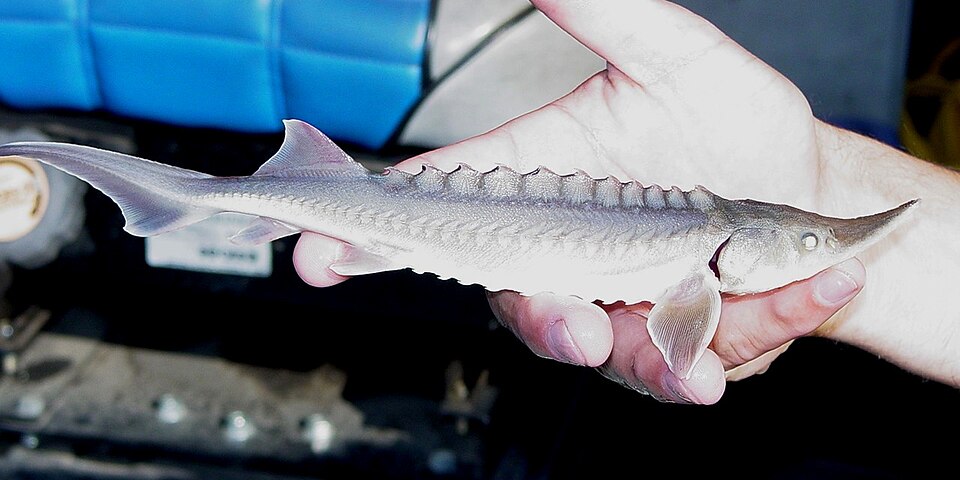
White sturgeon are the largest freshwater fish in North America, and most confusion happens with green sturgeon, since both share the same armored, shark-tailed body plan and overlapping range on the West Coast. White sturgeon are lighter gray to olive on top with a whitish belly, while green sturgeon run a duller olive-brown with a distinct pale stripe along each side. Count the bony plates called scutes: white sturgeon usually have 11 to 14 scutes in the row along the lateral line, green sturgeon have fewer, and green sturgeon also carry an extra scute row behind the anal fin that white sturgeon lack.
The other mix-up is with lake sturgeon in the Midwest and Mississippi drainage, which never overlap with white sturgeon in the wild but get confused on paper. Lake sturgeon have a shorter, more rounded snout and a shovel-shaped head, while white sturgeon have a longer, more tapered snout and can grow far larger, with confirmed fish topping 1,000 pounds. Both species share four whisker-like barbels in front of the mouth and a toothless, tube-shaped sucking mouth on the underside of the head, which separates any sturgeon from catfish or other bottom feeders at a glance.
The app forecasts these conditions for your spot, and learns which ones you catch on.
Season
Where it lives
White sturgeon live in the big rivers and estuaries of the Pacific coast, from the lower Columbia and Snake river systems through coastal California bays and rivers. They also thrive in reservoirs behind major dams on those same river systems, where they can grow undisturbed for decades.
Look for them in deep holes, river channels, and slow current seams near the bottom. They hold near structure like sunken logs, bridge pilings, and channel edges, and they move seasonally between brackish estuary water and freshwater upriver stretches to spawn over gravel and cobble in fast current.
What it eats
Sturgeon feed almost entirely along the bottom, using sensitive barbels to find food by smell and touch. They eat shad, smelt, anchovies, lamprey, crayfish, clams, and just about any dead or dying fish they can find. A big sturgeon will happily clean up a rotting salmon carcass, which is why cured or oily bait works so well.
How to catch it
This is heavy tackle fishing. Use a stout saltwater-class or heavy freshwater rod, a conventional reel loaded with braid, and a sliding sinker rig with a large circle hook. Fish it flat on the bottom in a deep hole or channel and let it sit still. Cured shad, smelt, herring, or grass shrimp are standard bait.
Sturgeon bites can be a subtle nudge or a slow steady pull, not a violent strike. Let the rod load up before you set the hook, and be ready for a long fight that can run twenty minutes or more even with a mid-size fish. Because these fish live so long and grow so slowly, most states require quick handling, keeping the fish in the water, and barbless circle hooks. Many waters are catch-and-release only or allow one tagged fish per year. Check your state's regulations closely before you target them, since rules vary a lot by river and change often.
- How big do white sturgeon get?
- They are the largest freshwater fish in North America. Most fish caught run 3 to 6 feet, but they can exceed 10 feet and over 1,000 pounds in rare cases, especially in large rivers and estuaries.
- What do white sturgeon eat?
- They feed on the bottom using their sucking mouth, taking crayfish, clams, worms, insect larvae, and dead or dying fish. Larger sturgeon will also eat live baitfish like smelt, shad, or salmon carcasses.
- When is the best time to catch white sturgeon?
- Spring and fall tend to produce the most consistent action, especially around river mouths and deep holes when water temperatures are moderate. Many anglers also do well at night or during low light in summer when the fish move shallower to feed.
- When do white sturgeon spawn?
- Spawning happens in spring to early summer, usually April through June, when adults move upriver over gravel or cobble bottoms in fast current. They do not spawn every year, and it can take a decade or more for a fish to reach maturity.
- Are white sturgeon good to eat?
- Yes, the meat is firm, mild, and often compared to halibut or swordfish. That said, many waters have strict slot limits or catch and release only rules because sturgeon grow slowly and take years to reach spawning age, so check regulations before keeping one.
- What gear do I need to catch a white sturgeon?
- Heavy tackle is standard: a stout rod, a reel with a strong drag, and 50 to 80 pound line or braid, since even average-sized sturgeon fight hard and can run for long distances. Fish cut bait or whole baitfish on the bottom near deep holes, channel edges, or current breaks.