

Yellow Perch
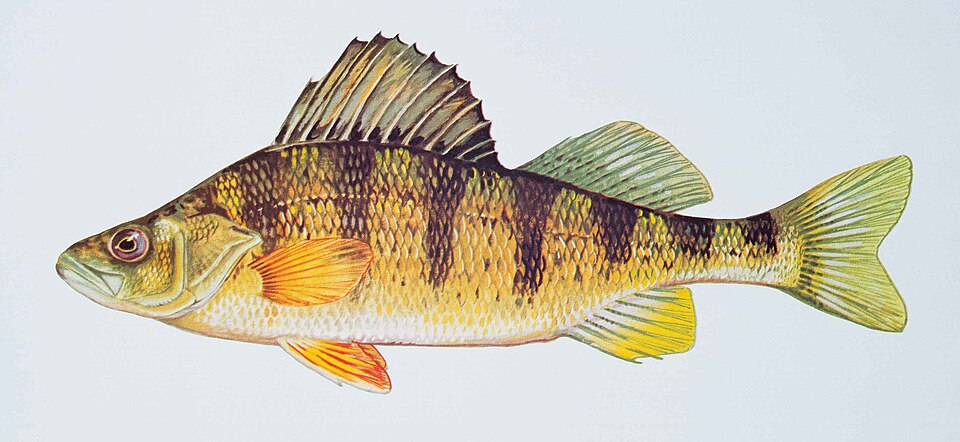
A schooling panfish with sweet, firm meat that many anglers rate above bluegill at the table. Yellow perch bite best in cold water, which makes them a good excuse to keep fishing through the winter.
Yellow perch have a golden-yellow to brassy body with six to eight dark, vertical bars running down the sides. Two separate dorsal fins, the front one spiny and the rear one soft, sit high on the back, and the lower fins often flush orange to red, especially in spawning males. The body is deep and slightly humped in front of the dorsal fin, tapering to a fairly small mouth with fine teeth, not the sandpaper-rough patches you find on walleye.
The main mix-up is with walleye and sauger, since all three share that perch-family body shape and spiny dorsal fin. Walleye and sauger grow much larger, have a more torpedo-shaped body, big glassy eyes, and lack the bold vertical bars, showing mottled or blotchy patterns instead. Smallmouth bass can also get confused for perch by beginners, but bass have a single continuous dorsal fin with a shallow notch, not two clearly split fins, and no vertical barring at all. If you see clean, ladder-like bars on a small golden fish, it is a yellow perch.</identification_md> <parameter name="faqs">[{"question": "When do yellow perch spawn?", "answer": "They spawn in early spring, right after ice-out in the north or as water hits the mid to upper 40s elsewhere. Females lay long, accordion-like ribbons of eggs over submerged vegetation or brush instead of building a nest."}, {"question": "What do yellow perch eat?", "answer": "Mostly insects, small crustaceans, and tiny minnows, along with their own young in some lakes. A small piece of nightcrawler, a minnow, or a tiny jig tipped with soft plastic covers almost every situation."}, {"question": "What is the best time to catch yellow perch?", "answer": "Early morning and evening in warmer months, but perch stay active and catchable through the middle of the day too, especially in cooler water. They are also one of the most reliable fish to target through the ice in winter."}, {"question": "How big do yellow perch get?", "answer": "Most run 6 to 10 inches, with a solid keeper closer to 10 to 12 inches. Anything over 12 inches is a genuinely big perch, often called a jumbo, and fish over a pound are trophies in most waters."}, {"question": "Are yellow perch good to eat?", "answer": "Yes, they have firm, white, mild-tasting fillets and are considered one of the better-eating freshwater fish, which is exactly why ice fishing crowds target them so heavily. The main downside is their small size means more filleting work per meal."}, {"question": "Do yellow perch travel in schools?", "answer": "Yes, and this is the key to catching them well. Find one and you have usually found dozens, often grouped tightly by size, so it pays to keep working the same spot once you get bit."}]
The app forecasts these conditions for your spot, and learns which ones you catch on.
Season
Where it lives
Yellow perch live in lakes, reservoirs, and slow rivers, usually over sand, gravel, or mud bottoms near weed beds. They school tightly and move as a group, so when you find one you usually find a dozen.
In North Carolina look for them in eastern rivers and lakes tied to the coastal plain, places like the Chowan River, the Roanoke, and lakes such as Mattamuskeet and Waccamaw. They also turn up in Virginia's tidal rivers and in South Carolina's larger reservoirs. They tolerate cold water well and stay active under ice further north, which is part of why they get fished hard in late winter here.
What it eats
Yellow perch eat small fish, insect larvae, worms, and crustaceans like grass shrimp and crayfish. They feed near the bottom and hunt mostly by sight, which is why they respond well to small, slow-moving baits.
How to catch it
A small minnow on a light jighead, fished slow near the bottom, is the standard rig. Drop it straight down over a school and lift it a few inches at a time. Yellow perch bite lighter than bluegill, so use a sensitive rod and pay attention to any soft tap.
Late winter into early spring is prime time, especially when perch stack up to spawn in tributary creeks and river mouths. A small spinner tipped with a worm works well then. Once you find a school, stay put. They move together, and a second cast in the same spot often out-produces a long search for new water.
- When do yellow perch spawn?
- They spawn in early spring right after ice out, once water temps hit the mid 40s to low 50s. Females lay long ribbons of eggs over vegetation or submerged brush, usually in shallow water near shore.
- What do yellow perch eat?
- Mostly insects, small crustaceans, and tiny baitfish, along with worms and fish eggs when they can find them. They feed in loose schools and will hit small jigs, minnows, and worms readily.
- What is the best time to catch yellow perch?
- Early morning and late afternoon in open water season, and almost any time of day through the ice in winter, since perch stay active under ice better than most gamefish.
- How big do yellow perch get?
- Most run 6 to 10 inches, with a solid keeper closer to 10 to 12 inches. Anything over 12 inches is a genuinely big perch, often called a jumbo.
- Are yellow perch good to eat?
- Yes, they have firm, mild, white fillets and are one of the most popular panfish on the table. This is a big reason they support winter ice fishing seasons across their range.
- Do I need to worry about limits on yellow perch?
- Many waters allow generous bag limits since perch are prolific, but some lakes with jumbo perch fisheries have tighter limits to protect big fish. Check local regulations before keeping a full cooler.