

Yelloweye Rockfish
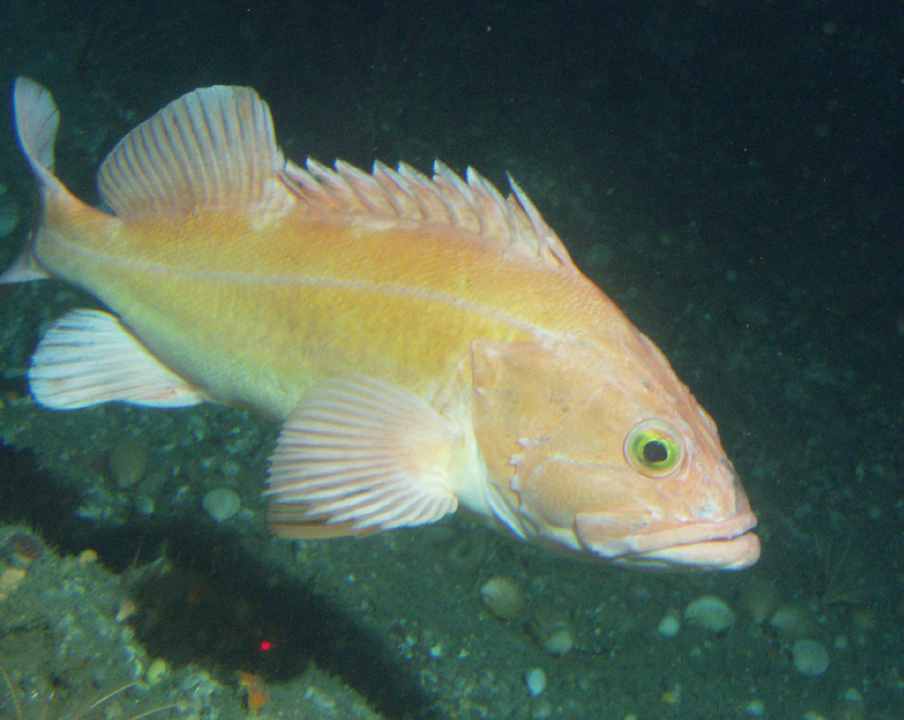
A deepwater rockfish famous for its bright orange-yellow body and long life. It is a prized catch off the Pacific coast, but it is also one of the most tightly regulated bottomfish in the country, so check your local rules before you target one.
Yelloweye rockfish are bright orange to orange-red overall, with solid bright yellow eyes that give them their name. Young fish have two rows of white blotches running down the back and sides, which fade as the fish ages, so a big old yelloweye is often just a solid, deep orange fish with no pattern left at all. The fins are heavy and spiny, and the anal fin is rounded rather than angled.
The main lookalike is the vermilion rockfish, which is also reddish-orange, but vermilion rockfish are more slender, have black speckling or mottling on the fins and body, and lack the glowing yellow eye. Canary rockfish can also cause confusion since both have yellow tones, but canary rockfish are more olive-yellow with gray mottling and a much slimmer build, without the deep orange base color. Yelloweye also grow far larger and heavier-bodied than either of these, with older fish developing a noticeably bulky, almost bull-nosed head and jaw.
The app forecasts these conditions for your spot, and learns which ones you catch on.
Season
Where it lives
Yelloweye rockfish live along the Pacific coast, from offshore waters down to deep rocky reefs and pinnacles. Adults hold over high-relief rock structure in depths from 300 to over 1,000 feet, though younger fish sometimes show up shallower, closer to nearshore reefs.
They are slow-growing and can live well past 100 years, which is part of why fishery managers watch this species so closely. A big yelloweye you catch today may have been alive before your grandparents were born.
What it eats
Yelloweye rockfish eat other fish, shrimp, crabs, and small bottom-dwelling creatures. They are ambush feeders that hold near rock cover and pick off prey that drifts or swims too close.
How to catch it
This is deep, technical bottom fishing. Heavy tackle is a must: stout rods, conventional reels loaded with braid, and enough weight, often a pound or more, to get baits or jigs straight down through current to the bottom. Whole herring, squid, or large jigs worked right on rocky structure are standard.
Because yelloweye live so deep and are so long-lived, many areas have strict bag limits, closed seasons, or require descending devices to release fish caught incidentally. In a lot of regions you may not be allowed to keep one at all. Always check current state and federal regulations before you fish for bottomfish, since rules on yelloweye change often and enforcement is serious.
- How big do yelloweye rockfish get?
- They are one of the largest rockfish species, commonly reaching 20 to 30 inches and over 20 pounds. Fish over 30 pounds have been recorded, and they can live well past 100 years, so a truly big one is likely very old.
- What do yelloweye rockfish eat?
- They feed on smaller fish, shrimp, crab, and other bottom-dwelling creatures. They are ambush feeders that hold near structure and grab prey that drifts or swims close by rather than chasing it far.
- Where and how deep do you find yelloweye rockfish?
- Yelloweye live over rocky reefs, pinnacles, and boulder fields, usually in deep water from 100 to 600 feet or more. Older, bigger fish tend to sit deeper than juveniles, which can be found in shallower rocky areas.
- Are yelloweye rockfish good to eat?
- Yes, the meat is white, firm, and mild, and it is considered one of the better-tasting rockfish. That reputation is part of why the species has been overfished in some areas.
- Can you catch and release yelloweye rockfish safely?
- Not easily. Because they are caught from very deep water, they almost always suffer barotrauma, and survival after release is poor unless you use a descending device to send them back down. Many areas have strict limits or closures on yelloweye specifically because of this.
- When is the best time to target yelloweye rockfish?
- There is no strong seasonal bite like with migratory fish since they hold on structure year round, but calm weather and slack tide make it much easier to keep bait or jigs on the bottom where they live. Always check current regulations before targeting them, since many fisheries limit or close yelloweye retention.