

Yellowfin Tuna
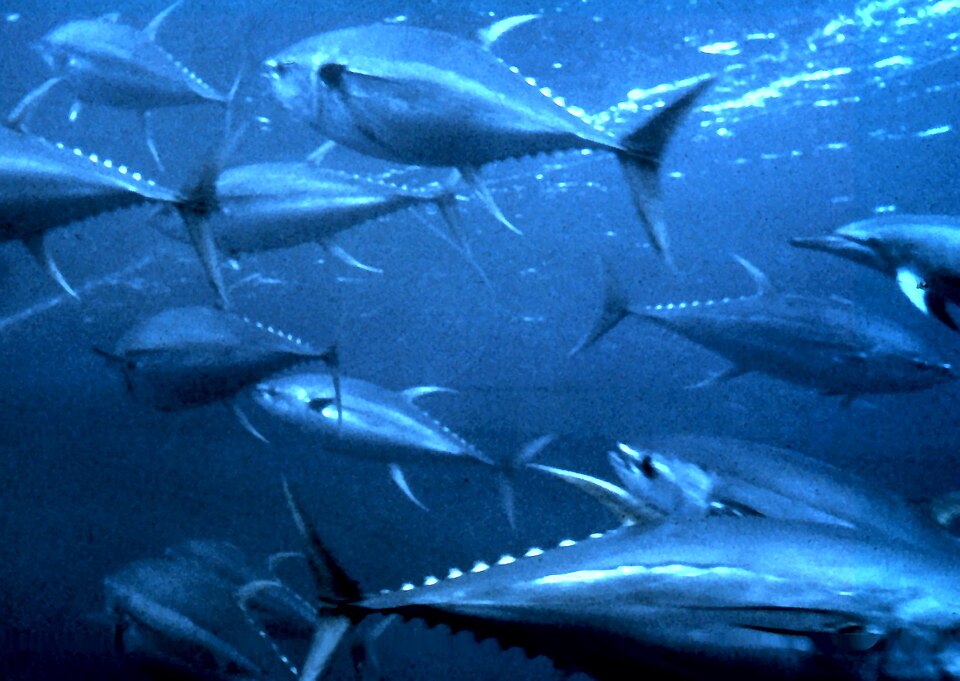
A fast, powerful open-water tuna prized for its fight and its table quality. Yellowfin push anglers and tackle to the limit, and landing one is a real offshore accomplishment.
Yellowfin tuna get mixed up with bigeye tuna and blackfin tuna, and out west, sometimes with albacore. The quickest tell on an adult yellowfin is the second dorsal fin and anal fin, which grow long and sickle-shaped, bright yellow, and can stretch far back toward the tail. Bigeye tuna have shorter, less dramatic fins and, as the name suggests, noticeably larger eyes for their body size. Yellowfin also run a lean, torpedo-shaped body with a metallic blue-green back, silver belly, and sometimes faint vertical lines on the sides.
Blackfin tuna are the smaller lookalike, common in warmer waters, and they simply do not get big. A blackfin tops out under fifty pounds while yellowfin regularly exceed a hundred and can push past two hundred. Finlets between the dorsal and anal fins and tail are yellow with a black edge on yellowfin, which helps separate them from blackfin when the fish is small. If you cut one open, yellowfin flesh is a deep red that fades to pink, similar to bigeye, so color of the meat will not settle an ID. When in doubt on a big fish, check the fin length and the finlet color together rather than relying on one feature alone.
The app forecasts these conditions for your spot, and learns which ones you catch on.
Season
Where it lives
Yellowfin tuna live in warm offshore waters, usually well beyond sight of land. They follow temperature breaks, current edges, and structure like weed lines, floating debris, and drop-offs where baitfish gather. Look for them around the Gulf's deep rigs and canyons, the Atlantic canyons off the mid-Atlantic and Northeast, and the offshore grounds of the Pacific coast from Southern California down through warmer summer and fall waters.
They are a schooling fish and often travel with porpoise pods, under birds working bait, or near floating objects. Depth varies with water temperature, but yellowfin commonly hold from the surface down to a few hundred feet, moving up to feed and dropping deeper during the day.
What it eats
Yellowfin eat baitfish, squid, and crustaceans in open water. Flying fish, small mackerel, sardines, and squid make up a large part of their diet. They feed aggressively near the surface at dawn and dusk and will chase bait balls hard, often boiling the surface in a feeding frenzy.
How to catch it
This is not a beginner shore fish. Yellowfin require a boat capable of running well offshore, and most anglers start out on a charter to learn the ropes. Trolling skirted lures or ballyhoo along temperature breaks and weed lines is the standard search method. Once fish are located or a chum slick draws them in, switch to chunking with cut bait on circle hooks, or cast poppers and stickbaits into a surface feeding frenzy for explosive strikes.
Heavy conventional or spinning gear in the 50 to 80 pound class is standard, with long fights common even on mid-size fish. Fluorocarbon leader helps since yellowfin can be leader shy in clear water. Early morning and evening bites are usually best. This is physically demanding fishing, so go with an experienced captain or crew before attempting it on your own boat.
- How big do yellowfin tuna get?
- Most caught fish run twenty to a hundred pounds, but yellowfin can grow past four hundred pounds in some fisheries. Anything over a hundred pounds is considered a solid fish by most offshore anglers.
- What do yellowfin tuna eat?
- They feed on smaller baitfish like sardines, flying fish, and squid, and they will chase schools of bait to the surface. Their diet shifts with whatever bait is thick in the area, so matching local forage matters more than any single lure.
- When is the best time to catch yellowfin tuna?
- Warmer months when water temperatures sit in the high sixties to low eighties tend to hold the most fish. Early morning and late afternoon bites are usually the most reliable, especially around temperature breaks, current edges, or floating structure.
- Do yellowfin tuna spawn, and does that affect fishing?
- Yes, they spawn in warm open water through the summer months and can spawn repeatedly during that stretch. Fishing generally stays good through the spawn since yellowfin keep feeding heavily to support it.
- Are yellowfin tuna good to eat?
- Yes, they are one of the most popular eating tunas, prized for sashimi and grilling because of their firm texture and mild flavor. Bleed and ice them quickly after landing to keep the meat quality high.
- Is there a size or bag limit on yellowfin tuna?
- Limits vary by region and sometimes by permit type, and some fisheries have minimum size requirements. Check current regulations for the specific waters you are fishing before you keep any fish.